 Skip to content

The Perfect Balance of Fire and Ice: Exploring Antisana and Papallacta Hot Springs
Ecuador is a land of dramatic geological contrasts, where the raw power of active volcanoes meets the soothing embrace of natural thermal waters. For travelers seeking a profound connection with the Andean landscape without the crowds of more commercial destinations, the Antisana and Papallacta journey stands as the ultimate short-haul expedition from Quito. This journey is not merely a tour but a sensory transition from the high-altitude winds of the páramo to the misty, rejuvenating cloud forests that hide the country’s most famous hot springs.
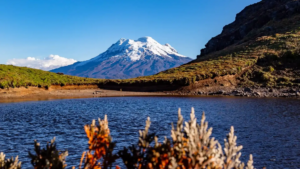
The Antisana Ecological Reserve: A Sanctuary of Volcanic Might
The adventure begins at the Antisana Ecological Reserve, a sanctuary that feels frozen in time. Standing at 5,704 meters, Antisana is the fourth highest volcano in Ecuador and offers a pristine look at a massive, glacier-topped mountain that remains one of the most imposing sights in the northern Andes. Unlike other parks, Antisana is characterized by its vast “lava flows” or volcanas, which have shaped the terrain into a lunar landscape of basaltic rock and golden grasslands. This area is world-renowned among birdwatchers as the most reliable place in Ecuador to spot the majestic Andean Condor. Watching this prehistoric bird, with its three-meter wingspan, soar over the lava-sculpted cliffs of the reserve is a humbling experience that highlights the vital importance of conservation.
Biodiversity and the Magic of the Mica Lagoon
As we traverse the reserve, we reach the Mica Lagoon, a stunning glacial lake that provides much of the drinking water for the city of Quito. The ecosystem here is known as the paramo, a high-altitude moorland that acts as a giant sponge, capturing moisture from the clouds. Here, the flora has adapted to extreme conditions; you will see the silver-leaved frailejones and the cushion plants that carpet the ground. It is also home to the Andean gull, the carunculated caracara, and the white-tailed deer. The silence of the highlands is profound, broken only by the wind, providing a rare sense of solitude that is hard to find in the modern world.
Papallacta Hot Springs: Rejuvenation at the Gateway to the Amazon
After exploring the rugged and chilly terrain of the volcano, the journey shifts toward physical and mental rejuvenation at the Papallacta Hot Springs. Located in a high-altitude cloud forest at the entrance of the Amazon basin, these natural thermal pools are heated by the volcanic heart of the earth and are famous for their high mineral content, including sulfates and bicarbonates, which are known for their healing properties.
The experience of soaking in warm waters while the cool Andean mist settles around you is the quintessential Ecuadorian “wellness” moment. It is the perfect conclusion to a day of hiking, allowing your muscles to relax and your mind to drift as you breathe in the oxygen-rich air of the surrounding forest. Columbus Ecuador has curated this experience to ensure that travelers enjoy the highest quality facilities, balancing the raw adventure of the mountains with the luxury of a world-class spa retreat.


FAQs: Your Comprehensive Guide to Antisana and Papallacta
Here are the most common questions travelers ask about Antisana and Papallacta
- What is the altitude of this trip and should I worry about it? The Antisana Reserve reaches altitudes of up to 4,000 meters (13,123 feet). While we travel by vehicle to most scenic points, the thin air can be felt. We recommend being in Quito for at least 24 hours before this trip. Papallacta is lower, at around 3,300 meters, which actually helps the body recover after being in the higher altitudes of the reserve.
- What wildlife can I realistically expect to see? Antisana is a premier destination for high-altitude photography, though sightings of its most iconic residents require patience. The Andean Condor is a rare sight, with fewer than 150 individuals remaining in the Ecuadorian Andes, making any encounter a truly extraordinary event. Similarly, the Spectacled Bear and the Andean Fox are elusive and inhabit the more rugged, distant terrain. Near the Mica Lagoon, you are more likely to observe specialized birds such as the Andean Teal and Silvery Grebe, alongside herds of white-tailed deer. While the “Big Three” are rare, the search for them defines the spirit of an authentic Andean expedition.
- What should I pack for such a varied climate? Preparation is key. You will experience freezing winds at Antisana and humid, warm conditions at the hot springs. We suggest a “three-layer” system: a thermal base, a fleece for warmth, and a waterproof windbreaker. Don’t forget your swimwear for Papallacta and plenty of sunblock, as the equatorial UV rays are extremely strong at high altitudes.
- Why are the hot springs in Papallacta considered medicinal? The water originates from melting glaciers and underground aquifers that pass through deep volcanic cracks. As the water travels, it absorbs high concentrations of sulfates, sodium, and calcium. These minerals are known to have anti-inflammatory properties and are excellent for treating skin conditions and muscle fatigue.
- Is Antisana better than Cotopaxi for wildlife? While Cotopaxi is more famous for its symmetry, Antisana is widely considered superior for wildlife sightings. Because it receives fewer visitors, animals like the Andean fox, the white-tailed deer, and the Condor are much less shy. For serious nature photographers, Antisana is often the top recommendation from Columbus Travel.