 Skip to content

How to Travel from Quito to Cotopaxi: The Complete Highland Expedition
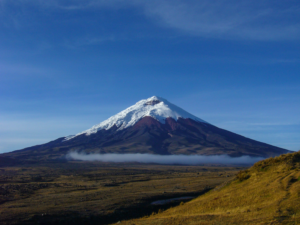
Exploring the snow-capped Andes is a highlight of visiting South America, and learning how to travel from Quito to Cotopaxi opens the door to one of the world’s highest active volcanoes. Standing at $5,897$ meters ($19,347$ feet), Cotopaxi Volcano dominates the skyline south of Ecuador’s capital.
Whether you are looking to hike up to glacial glaciers, photograph wild horses near alpine lagoons, or downhill mountain bike through paramo grasslands, understanding your transportation options ensures a smooth journey.
Planning a high-altitude adventure requires expertise and detailed coordination. By choosing Columbus Ecuador, you can rest assured that your journey is in the hands of seasoned local professionals dedicated to crafting a seamless, safe, and unforgettable Andean expedition.
Why Travel from Quito to Cotopaxi?
Cotopaxi National Park protects over 33,000 hectares of high-altitude ecosystems. Located along the famous Avenue of the Volcanoes, the park provides an incredible contrast to Quito’s urban atmosphere.
Mastering how to travel from Quito to Cotopaxi allows you to leave the city morning traffic behind and stand among high-altitude paramo meadows in less than two hours.
| Travel Method | Duration to Park Gate | Approximate Cost (USD) |
| Private Guided Tour | 1.5 hours | $90 – $160 per person |
| Rental Car (4×4) | 1.5 hours | $50 – $90 / day |
| Public Bus | 2 hours (to highway) | $2.50 + taxi fare |
| Shared Day Tour | 1.5 to 2 hours | $50 – $75 per person |
How to Travel from Quito to Cotopaxi by Private Tour or Transfer
For travelers wanting direct access to park trails without logistical delays, booking a private excursion is the most seamless method.
When you organize how to travel from Quito to Cotopaxi with an experienced agency like Columbus Ecuador, a private guide and driver manage high-altitude mountain transport, park registration, and route navigation.
Key Benefits of Private Excursions:
- Direct Access to High Parking: Drive straight past the control gates up to the Carrel Parking Lot at $4,500$ meters ($14,763$ feet).
- Included Mountain Gear: Private tours frequently supply trekking poles, high-altitude safety equipment, and warm mountain gear.
- Custom Hiking Pace: Adjust your ascent up to the José Rivas Refuge ($4,864$ meters) around your personal acclimatization level.

How to Travel from Quito to Cotopaxi by Public Bus
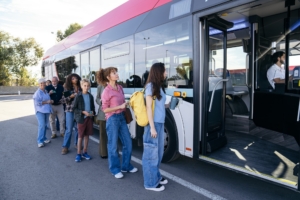
If you are a budget traveler researching how to travel from Quito to Cotopaxi, taking a public bus along the Pan-American Highway is possible, though it requires an additional transfer at the park entrance.
Step 1: Departure from Quitumbe Terminal
Head to the Terminal Terrestre Quitumbe in southern Quito (accessible via the Quito Metro or taxi).
Step 2: Board a Southbound Bus
Purchase a ticket on any interprovincial bus heading south toward Latacunga, Ambato, or Baños.
- Instruction: Tell the bus conductor you need to get off at the Chasqui entrance to Cotopaxi National Park (El Chasqui / Entrada al Parque Nacional Cotopaxi).
- Cost: The bus fare is roughly $2.50 to $3.00 USD per person.
- Duration: The bus ride takes approximately 1.5 hours.
Step 3: Hire a Local 4×4 Truck at the Highway
The public bus drops passengers off on the Pan-American Highway, which sits roughly 15 kilometers from the actual park attractions. From the highway junction at Chasqui, you must hire a local licensed 4×4 truck driver to take you into the national park (cost ranges between $45 and $60 USD for the day).
How to Travel from Quito to Cotopaxi by Car: Driving Route Guide
Driving yourself gives you independence to explore hidden viewpoints inside the national park. Here is how to travel from Quito to Cotopaxi behind the wheel:
- Drive south out of Quito along the main Pan-American Highway South (E35).
- Pass the town of Machachi and enter Cotopaxi Province.
- Look for the clearly marked highway signs for Parque Nacional Cotopaxi near Chasqui (Kilometer 42 south of Quito).
- Turn left off the highway onto the asphalt access road leading to the Control Caspala entrance gate.
Important Vehicle Note: While the initial road to the visitor center is paved, continuing up to Limpiopungo Lagoon and the Carrel Refuge parking lot requires driving over rough dirt roads and unpaved riverbeds. Renting a 4×4 or high-clearance SUV is strongly recommended.
Must-See Highlights Inside Cotopaxi National Park
Once you complete your journey south from Quito, several key attractions await inside the park boundaries:
1. Limpiopungo Lagoon
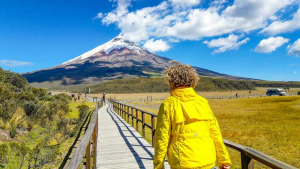
Located at $3,800$ meters ($12,467$ feet), this high-altitude lake features a flat 6-kilometer loop trail. It offers reflections of Cotopaxi’s glaciers and excellent birdwatching for the Andean lapwing and caracara.
2. José Rivas Refuge Hike
Hike up the steep zig-zag scree trail from the parking lot to the mountaineering refuge at $4,864$ meters ($15,958$ feet) for warm coca tea and mountain views.
3. Mariscal Sucre Visitor Center
Learn about the volcanic history, geology, and native wildlife of the Andes through interactive museum exhibits.
If you plan to combine your volcano tour with trips to Quilotoa, Baños, or the Amazon, explore our complete mountain itineraries on Columbus Ecuador.
Frequently Asked Questions (FAQs)
Here are the most common questions travelers ask
How long does it take to travel from Quito to Cotopaxi?
The drive from Quito to the main entrance gate of Cotopaxi National Park takes approximately 1.5 hours. Reaching the upper parking lot at the base of the glacier takes an additional 45 minutes inside the park.
Do you need a guide when deciding how to travel from Quito to Cotopaxi?
While entering the national park independently is permitted, hiring a certified naturalist guide is highly recommended for safety, high-altitude navigation, and understanding the geological history of the volcano.
What is the entrance fee for Cotopaxi National Park?
Entrance to Cotopaxi National Park is completely free for both international tourists and national residents. Visitors must present a valid passport or ID card at the registration control gate.
How cold does it get when you travel from Quito to Cotopaxi?
Temperatures inside the park fluctuate rapidly. While valley temperatures range from $10^\circ\text$ to $15^\circ\text$ ($50^\circ\text$ to $59^\circ\text$), temperatures at the refuge parking lot can drop below freezing ($0^\circ\text$ / $32^\circ\text$) with high mountain winds.
Can you visit Cotopaxi without hiking to high altitudes?
Yes. Visitors who prefer not to hike can enjoy flat walks around Limpiopungo Lagoon, visit the interpretation center, or enjoy hot cocoa at historic haciendas along the park border.